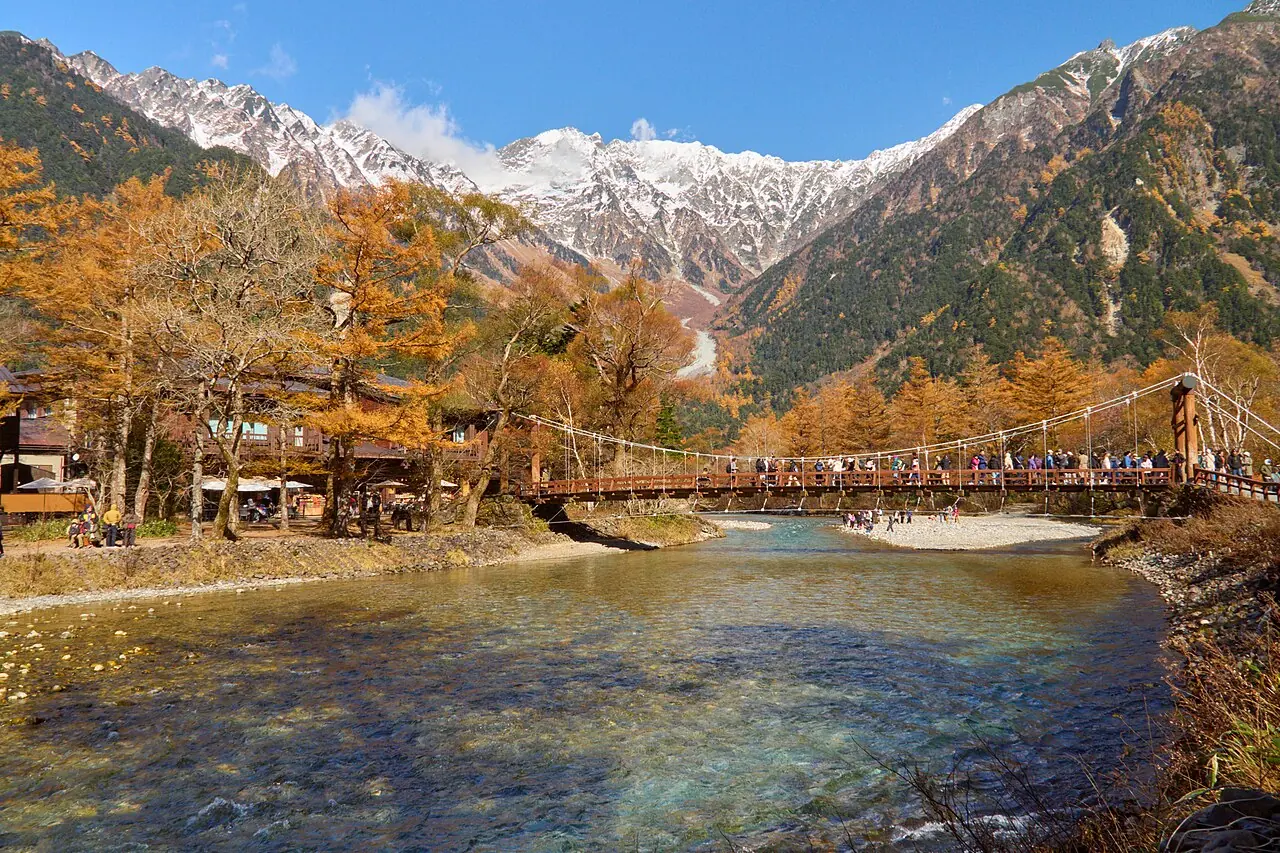
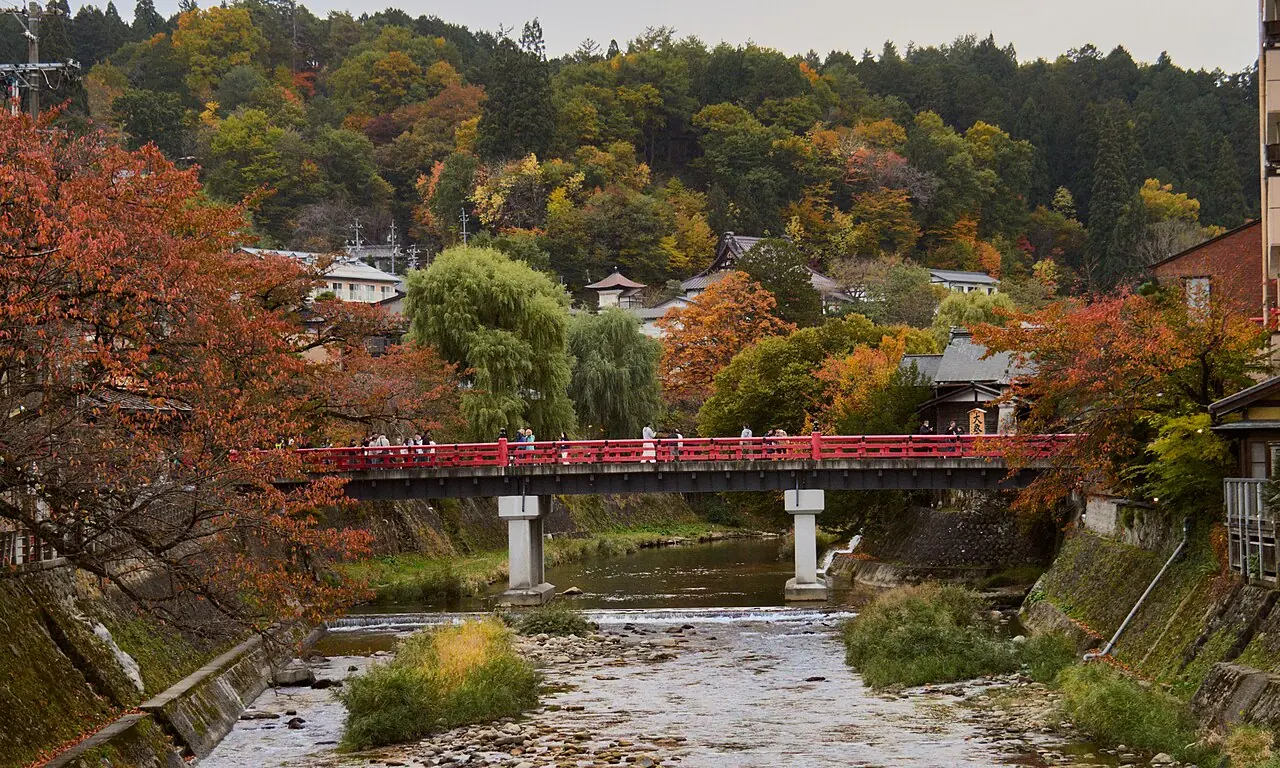
Kappa Bridge over the Azusa River, Kamikochi (autumn). Photo: lumoplank / Wikimedia Commons / CC0

- You can travel the whole Kanazawa – Shirakawa-go – Takayama – Matsumoto – Hakuba corridor by bus and train, but each bus company has its own reservation rule.
- Kamikochi buses and the Tateyama Kurobe Alpine Route are seasonal: in 2026 the last Kamikochi buses run on November 15, and the Alpine Route is open until November 30.
- On the bus-only legs, single tickets cost far less than a regional pass: Kanazawa to Shirakawa-go to Takayama is ¥5,600 in single tickets (¥5,800 from December 1, 2026) against ¥19,800 for the Takayama-Hokuriku pass.
From spring to autumn, base yourself in Takayama, then Matsumoto, and buy single bus tickets.
Takayama puts Shirakawa-go and, from April to November, Kamikochi within a day trip. Matsumoto adds Kamikochi from the other side plus the train to Hakuba.
On the bus legs alone, single tickets from Kanazawa to Takayama via Shirakawa-go cost ¥5,600 through November 30, 2026 (¥5,800 from December 1), against ¥19,800 for the Takayama-Hokuriku pass.
- 1TakayamaShirakawa-go and Kamikochi as day trips (Kamikochi April 17 – November 15, 2026)
- 2MatsumotoKamikochi from the other side and the JR Oito Line to Hakuba
- 3HakubaPair it with Takayama in winter, when Kamikochi is closed
Can you do the Japanese Alps without a car? (Quick answer by season)
Yes, from spring to autumn you can reach every major stop on the corridor by public transport. Winter is different: two of the high-mountain routes close completely, and last winter some Nagano – Hakuba buses were reservation-only.
| Place | Spring–autumn | Winter |
|---|---|---|
| Kanazawa → Shirakawa-go → Takayama | Bus | Bus (some departures off Dec 29–Jan 3, snow delays) |
| Takayama → Matsumoto | Bus via Hirayu | Not yet confirmed for 2026–27 |
| Kamikochi | Bus, Apr 17–Nov 15 (2026) | No buses |
| Tateyama Kurobe Alpine Route | Apr 15–Nov 30 (2026) | Closed Dec–Apr 14 |
| Nagano → Hakuba | Bus, no reservation | Bus, some reserved (2025–26) |
Dates are for the 2026 season and were checked against each operator's site on October 15, 2026. The winter rows for Hakuba are last winter's pattern; the winter 2026–27 timetable has not been published yet.
Swipe sideways to see the whole diagram →
The car-free corridor at a glance
The usual line runs west to east: Kanazawa → Shirakawa-go → Takayama → Kamikochi → Matsumoto → Hakuba. Buses do almost all of the work in the west; trains take over between Matsumoto and Hakuba.
- Kanazawa is the gateway from the Hokuriku coast and from Kyoto and Osaka.
- Shirakawa-go sits on the bus line between Kanazawa and Takayama, so most people stop there on the way rather than making a separate trip.
- Takayama is the hub for Shirakawa-go, Kamikochi and the bus over the mountains to Matsumoto.
- Matsumoto connects to Kamikochi (by train and bus) and to Hakuba (by the JR Oito Line). It is also the way into the Nakasendo: the 10:20 local train on the JR Chuo Line reaches Narai, a post town on the old road, at 11:12 with no change (November 2026 timetable, every day). The Nakasendo trail guide covers the Kiso Valley post towns.
- Hakuba is the ski end of the corridor; the Hakuba without a car guide covers getting around the valley.

Route-by-route transit table
My own table of every car-free link on the corridor, built from the operators' timetables and fare pages. Fares are one-way adult fares in yen.
| Leg | Operator | Time | Fare | Reservation | Winter |
|---|---|---|---|---|---|
| Kanazawa → Shirakawa-go | Hokutetsu / Nohi bus | 1 hr 15 min | ¥2,800 (¥2,900 from Dec 1) | Seat reservation | Runs |
| Shirakawa-go → Takayama | Nohi / Hokutetsu bus | about 50 min | ¥2,800 (¥2,900 from Dec 1) | Some departures | Some off Dec 29–Jan 3 |
| Kanazawa → Takayama (through ticket) | Hokutetsu / Nohi bus | 2 hr 15 min | ¥4,200 (¥4,400 from Dec 1) | Seat reservation | Runs |
| Takayama → Matsumoto | Nohi / Alpico bus via Hirayu | 2 hr 30 min – 2 hr 50 min | ¥4,400 | Required | Not confirmed |
| Takayama → Kamikochi | Nohi bus, change at Hirayu | Hirayu → Kamikochi about 30 min | ¥3,000 | Not possible | Last buses Nov 15 |
| Matsumoto → Kamikochi | Alpico train + bus via Shin-Shimashima | about 30 min + 1 hr 5 min | ¥3,100 (bus only) | Reserved passengers first | Last buses Nov 15 |
| Tateyama Station → Ogizawa | Alpine Route | — | ¥10,940 | Web ticket by 15:00 the day before (limited from Nov 4) | Open until Nov 30 |
| Nagano → Hakuba Happo | Alpico express bus | 1 hr 10 min – 2 hr 5 min | ¥2,900 (spring–autumn) | None (spring–autumn) | Some reserved (2025–26) |
| Matsumoto → Hakuba | JR Oito Line | — | — | Not needed (local trains) | Runs |
Checked against the operators' sites on October 15 and 16, 2026. "—" means I have not confirmed this figure yet. The ¥3,100 Kamikochi fare is the bus from Shin-Shimashima only; the train from Matsumoto is extra.
Kanazawa – Shirakawa-go – Takayama
Kanazawa → Takayama goes from ¥4,200 to ¥4,400, and each leg via Shirakawa-go from ¥2,800 to ¥2,900.
Hokutetsu and Nohi run the joint bus line: nine departures a day from Kanazawa (8:10–16:00) and nine from Takayama (7:50–16:30). Nohi also runs 16 round trips a day between Takayama and Shirakawa-go.
Break the trip at Shirakawa-go and the through ticket no longer covers you: the operators treat the rest of the ticket as void, so you pay each leg separately. Kanazawa → Takayama in one go is ¥4,200; stopping in Shirakawa-go costs ¥2,800 + ¥2,800 = ¥5,600, so the stop adds ¥1,400. From December 1, 2026 the stop costs ¥5,800, and the difference stays ¥1,400.
Hokutetsu runs the buses to and from Kanazawa as reserved-seat services: book from one month before travel through Hassha Orai Net, linked from Hokutetsu's route page, or by phone. On buses that run only between Takayama and Shirakawa-go, departures marked R in Nohi's timetable require a reservation (Nohi sells them on Japan Bus Online); departures without the mark are unreserved and cannot be booked.

Takayama – Matsumoto (via Hirayu)
Nohi quotes about 2 hours 20 minutes for the highway bus over the mountains, but the timetabled runs take 2 hours 30 minutes to 2 hours 50 minutes. There are six departures from Takayama and seven from Matsumoto (some seasonal). The fare is ¥4,400, and a reservation is required: online from one month ahead until 30 minutes before the bus leaves its first stop.
Winter running for 2026–27 is not confirmed on the operator's site. If the bus is not running, the rail detour goes through Nagoya.
Takayama or Matsumoto – Kamikochi (seasonal)
No private cars or rental cars are allowed past the Kama Tunnel at any time of year, so everyone arrives by bus or taxi.
From Takayama — Nohi bus via Hirayu Onsen
- Change at Hirayu Onsen; Hirayu to Kamikochi takes about 30 minutes.
- ¥3,000 one way on the through ticket (¥5,800 return, valid 7 days).
From Matsumoto — train and Alpico bus via Shin-Shimashima
- Alpico Kamikochi Line train to Shin-Shimashima, about 30 minutes.
- Bus to Kamikochi, about 1 hour 5 minutes, ¥3,100.
Both companies run from April 17 to November 15 in 2026.
Toyama – Ogizawa: the Tateyama Kurobe Alpine Route
The Alpine Route crosses the range by cable car, ropeway and trolley bus between Tateyama Station (Toyama side) and Ogizawa (Nagano side). The through fare is ¥10,940 one way or ¥19,680 return; the train from Toyama to Tateyama is extra.
Web tickets must be bought by 15:00 the day before and fix your departure time at the entry station; if they sell out, same-day tickets are still sold at the station. From November 4 the web tickets are restricted, because snow can disrupt the highland bus road. From November 4 to 10 they cover departures until 10:40 from Tateyama Station and until 13:00 from Ogizawa. From November 11 to 30 they are sold only for trips from Ogizawa (until 13:00) going no farther than Murodo; from Tateyama Station you need a same-day ticket. Check the operator's notice before you plan a late-season crossing. The route is open from April 15 to November 30 in 2026.
Nagano – Hakuba (and the Matsumoto question)
From Nagano Station's east exit, Alpico express buses reach Hakuba Happo in 1 hour 10 minutes to 2 hours 5 minutes for ¥2,900 (spring–autumn timetable, to November 30). No reservation is needed in that season; you buy the ticket at the counter or on board. Last winter (December 13, 2025 – March 31, 2026), Alpico ran both reservation-only buses and non-reserved buses, most of which ran non-stop between Nagano Station and Hakuba Happo. Stops varied by bus, and some ran only on certain days.
From Matsumoto there are two options:
JR Oito Line — no booking needed
- In the November 2026 timetable, two local trains run straight through from Matsumoto to Minami-Otari every day, at 9:20 and 11:09; the Azusa limited express leaves for Hakuba at 10:41.
Direct bus — winter 2026–27 not announced
- Last winter Alpico ran one direct bus a day from Matsumoto to Hakuba (December 13, 2025 – March 8, 2026, ¥3,500, reserved seats, booked online only).
The Matsumoto to Hakuba guide compares both.

Getting into the Alps from Tokyo, Nagoya, Kyoto and Osaka
| From | To | How | Time | Fare |
|---|---|---|---|---|
| Nagoya (Meitetsu Bus Center) | Takayama | Nohi highway bus, reserved | about 2 hr 45 min | ¥3,600 (¥3,300 online) |
| Nagoya (Meitetsu Bus Center) | Shirakawa-go | Highway bus | about 2 hr 30 min | ¥3,600–¥4,700 depending on the date |
| Nagoya (Meitetsu Bus Center) | Kanazawa | Highway bus | — | ¥5,000–¥6,000 depending on the date |
| Shinjuku | Takayama | Nohi highway bus, reserved | about 5 hr 45 min | ¥8,000–¥8,500 depending on the date (night bus +¥1,000) |
For trains from Tokyo and Osaka, see "Getting to the Japanese Alps from Tokyo or Osaka" near the end of this page. I have not confirmed the rail fares yet, so check them with JR before you book. From Kyoto or Osaka, the two practical entry points are Nagoya (for Takayama) and Kanazawa (for Shirakawa-go).
Booking rules differ by route
| Route | Rule | When booking opens |
|---|---|---|
| Takayama – Nagoya / Shinjuku | All seats reserved; online bookings are canceled if not paid within 3 days | 1 month ahead |
| Kanazawa – Shirakawa-go – Takayama | To or from Kanazawa: reserved seats only. Takayama – Shirakawa-go only: required on departures marked R | 1 month ahead |
| Takayama – Matsumoto | Reservation required | 1 month ahead, until 30 min before departure |
| Takayama / Hirayu – Kamikochi (Nohi) | Unreserved only, no booking | — |
| Shin-Shimashima – Kamikochi (Alpico) | Reserved passengers first | Midnight, 1 month ahead |
| Alpine Route | Web ticket optional (limited from Nov 4); same-day tickets sold | Until 15:00 the day before |
| Nagano – Hakuba | Spring–autumn: no reservation. Winter 2025–26: some buses reservation-only, others non-reserved | 2 months ahead (winter 2025–26) |
On the Shirakawa-go line, book every bus that starts or ends in Kanazawa: Hokutetsu asks all passengers to reserve. For a Takayama – Shirakawa-go trip, check Nohi's timetable: departures marked R require a reservation, those without it cannot be booked, and Nohi sells mobile tickets for them.
Passes vs single tickets: which saves money?
| Option | Price | Covers |
|---|---|---|
| Single tickets, Kanazawa → Shirakawa-go → Takayama | ¥5,600 (¥5,800 from Dec 1) | The two bus legs |
| Takayama-Hokuriku Area Tourist Pass | ¥19,800, 5 days | JR Nagoya – Toyama, Kyoto – Tsuruga, Osaka – Kansai Airport, Hokuriku Shinkansen Toyama – Tsuruga, and the Takayama – Shirakawa-go – Kanazawa/Toyama buses (reservation needed) |
| Alpine-Takayama-Matsumoto Area Tourist Pass | ¥24,500, 5 days | JR Nagoya – Toyama and Shinano-Omachi – Nagoya, plus the whole Alpine Route |
| Japan Rail Pass (ordinary, 7 days) | ¥50,000 online | JR lines nationwide; not the Alpine Route |
On the buses alone, the Takayama-Hokuriku pass costs ¥14,200 more than single tickets (¥19,800 − ¥5,600), or ¥14,000 from December 1 (¥19,800 − ¥5,800). My pick: buy single tickets unless you are also riding long JR legs, such as Osaka or Kyoto to the Hokuriku coast, within the same five days.
The Alpine-Takayama-Matsumoto pass only makes sense with the Alpine Route, and for 2026 it is sold overseas until November 6 and valid until November 10. Japan Rail Pass prices are subject to change; check the official price page before you buy. My itinerary guide adds up the confirmed bus fares for its 5- and 7-day plans.
Traveling with luggage
Large suitcases are the weak point of a bus-based trip. On the Takayama – Shirakawa-go line the luggage space is shared and limited, so big bags may not fit, and the operator does not cover damage or loss.
The rule for skis and snowboards is stricter. Hokutetsu's page for the Kanazawa – Shirakawa-go – Takayama line says long items such as skis and snowboards are not allowed, both on board and in the luggage hold. If you are bringing your own gear for Hakuba, send it ahead instead of carrying it on this line.
- Takayama Station lockers: small ¥400, medium ¥600, large ¥700; cash only, open 24 hours, up to three days.
- Shirakawa-go: the bus terminal has coin lockers (the tourist association does not list prices or hours). A bag storage service takes bags from 8:00 to 17:00 for the same day only: from ¥500 for small and medium bags, from ¥1,000 for large. If it is full, the tourist association also keeps bags.
- Same-day delivery in Takayama: a local service carries bags from the station or hotels to set points in the old town; booking is required.
- Alpine Route baggage service: ¥4,000 per item, cash only, between Dentetsu-Toyama and Shinano-Omachi; in 2026 it ends on November 8.
Yamato carries a 160-size case within the Chubu region for ¥2,510 (cash price). Send it to your second base and travel the bus legs with a day pack.

Winter: what closes and what keeps running
The last Kamikochi buses run on November 15, 2026. The Alpine Route is open until November 30, then closed until April 14.
| What | Winter status (checked October 15, 2026) |
|---|---|
| Kamikochi buses | Last buses November 15, 2026 |
| Tateyama Kurobe Alpine Route | Open until November 30, then closed until April 14 |
| Alpine-Takayama-Matsumoto pass | Valid only until November 10, 2026 |
| Alpine Route baggage service | Ends November 8, 2026 |
| Gokayama Suganuma bus stop | April to November only |
| Takayama – Shirakawa-go buses | Some departures do not run Dec 29 – Jan 3; heavy snow can delay buses by 2 hours or more |
| Nagano – Hakuba buses | Mix of reservation-only and non-reserved buses (2025–26 pattern) |
| Matsumoto – Hakuba direct bus | Ran Dec 13, 2025 – Mar 8, 2026; 2026–27 not announced |
Fares on the Kanazawa – Shirakawa-go – Takayama line rise on December 1, 2026 (see the transit table). The JR Takayama Line between Takayama and Toyama has had long suspensions after damage, most recently from March 2026, so check JR West's service information before you rely on it. When the line is closed, the Nohi bus from Takayama to Toyama costs ¥3,800. Nohi lists this route among those whose fares change on December 1, 2026, but has not published the new fare, so check it before you ride.
- Whether the Takayama – Matsumoto bus runs in winter 2026–27
- The winter 2026–27 Nagano – Hakuba timetable and fares
- Whether the Matsumoto – Hakuba direct bus runs in winter 2026–27
Where to base yourself
| Base | Good for | Bus links |
|---|---|---|
| Takayama | Shirakawa-go, Kamikochi, Matsumoto | 16 round trips a day to Shirakawa-go; Kamikochi via Hirayu; 6 buses to Matsumoto |
| Matsumoto | Kamikochi, Hakuba | Train + bus to Kamikochi; JR Oito Line to Hakuba |
| Kanazawa | Shirakawa-go on the way in | 9 buses a day to Shirakawa-go and Takayama |
| Hakuba | Skiing, summer hiking | Express bus from Nagano; JR from Matsumoto |
My pick for spring to autumn: Takayama first, then Matsumoto. Takayama puts Shirakawa-go and Kamikochi within a day trip, and Matsumoto adds Kamikochi from the other side plus the train to Hakuba. In winter, with Kamikochi closed, pair Takayama with Hakuba instead.

Sample routes (3, 5 and 7 days)
- 3 days: Kanazawa → Shirakawa-go (stop) → Takayama (2 nights). Day 3: Kamikochi day trip in season, or the Takayama old town in winter.
- 5 days: add Takayama → Matsumoto by the Hirayu bus (¥4,400, reserve), then Matsumoto (2 nights) with Kamikochi from the Matsumoto side.
- 7 days: add Matsumoto → Hakuba on the JR Oito Line and two nights in Hakuba.
Day-by-day plans, with the bus fares I could confirm, are in the Japanese Alps itinerary without a car.
How I checked this
Every fare, time and date above comes from the operators' own pages (Nohi Bus, Hokutetsu, Alpico Kotsu, Tateyama Kurobe Kanko, JR East, JR West and Yamato), read in Japanese where the English page is shorter. Each figure carries the date I read it. Where a company has not published next season's details yet, the table says so instead of guessing.
Getting to the Japanese Alps from Tokyo or Osaka
Take the Hokuriku Shinkansen to Kanazawa; JR West lists Tokyo – Kanazawa at 2 hours 28 minutes. Or start from Matsumoto: the Azusa 5 limited express leaves Shinjuku at 8:00 and reaches Matsumoto at 10:37 and Hakuba at 11:40 (November 2026 timetable). I have not confirmed the fares.
JR West's HOKURIKU One-way Ticket covers Osaka to Kanazawa in ordinary seats on the Thunderbird limited express and the Hokuriku Shinkansen from Tsuruga, for ¥8,000 (adult; price shown as of February 5, 2025). It is only for holders of a foreign passport entering Japan as temporary visitors, and it is sold by select overseas travel agencies, not in Japan. I have not confirmed the travel time or the regular fare.
Frequently asked questions
Can you visit the Japanese Alps without a car?
Yes. Buses link Kanazawa, Shirakawa-go and Takayama, a highway bus runs from Takayama to Matsumoto via Hirayu, and express buses run from Nagano to Hakuba. Private cars are not allowed into Kamikochi at all, so the bus is the normal way in.
Do I need to reserve buses in the Japanese Alps?
It depends on the company. Takayama – Matsumoto buses need a reservation. On the Shirakawa-go line, buses to and from Kanazawa are reserved-seat only, bookable up to one month ahead; on buses that run only between Takayama and Shirakawa-go, departures marked R in Nohi's timetable require a reservation and the others are unreserved. Nohi's Kamikochi buses cannot be reserved at all, and Alpico's Kamikochi buses give priority to people who reserved.
Is the Alpine-Takayama-Matsumoto pass worth it?
Only if you use the Tateyama Kurobe Alpine Route plus JR trains south of Shinano-Omachi. The pass costs ¥24,500 for 5 days. For 2026, overseas sales end on November 6 and the pass can be used until November 10; the next season has not been announced.
Can I visit Kamikochi or the Alpine Route in winter?
No. In 2026 the Kamikochi buses run until November 15 and the Alpine Route until November 30. The Alpine Route is closed from December to April 14.
Can I take big suitcases on Alps buses?
Not always. On the Takayama – Shirakawa-go line the luggage space is shared and limited, so large bags may not fit. Leave big cases in a locker or bag storage, or send them ahead. Skis and snowboards are not allowed on the Kanazawa – Shirakawa-go – Takayama buses.
Keep planning
Sources
- Shirakawa-go FAQ: luggage and the shuttle bus (Japanese) — Shirakawa-go Tourist Association
- Shirakawa-go line (English) — Nohi Bus
- Kanazawa – Shirakawa-go – Takayama highway bus — Hokutetsu
- Takayama – Matsumoto highway bus (English) — Nohi Bus
- Kamikochi line — Nohi Bus
- Shin-Shimashima – Kamikochi bus — Alpico Kotsu
- Tateyama Kurobe Alpine Route (English) — Tateyama Kurobe Kanko
- November web tickets (notice, in Japanese) — Tateyama Kurobe Kanko
- Nagano – Hakuba express bus — Alpico Kotsu
- Nagano – Hakuba winter timetable (2025–26) — Alpico Group
- Takayama-Hokuriku Area Tourist Pass — JR West
- Hokuriku Shinkansen — JR West
- HOKURIKU One-way Ticket (Discounted One-way Ticket) — JR West
- Limited express Azusa 5 timetable (November 2026) — JR East
- Local train 1826M, Matsumoto – Nakatsugawa (November 2026) — JR East
- Alpine-Takayama-Matsumoto Area Tourist Pass — JR West
- Shirakawa-go, Kanazawa and Toyama buses: timetable and fares — Nohi Bus
- Fare change from December 1, 2026 — Nohi Bus
- Takayama – Nagoya highway bus — Nohi Bus
- Highway bus timetable and day tours (March 2026) — Nohi Bus
- Takayama – Shinjuku highway bus — Nohi Bus
- Alpine Route fares — Tateyama Kurobe Alpine Route
- Alpine Route web tickets — Tateyama Kurobe Alpine Route
- Oito Line timetable from Matsumoto, November 2026 — JR East
- Japan Rail Pass prices — Japan Rail Pass
- Coin lockers in Takayama — Takayama City
- TA-Q-BIN rates — Yamato Transport